


LLC Operating Agreement In Georgia (Nov. 2026) – FREE Templates & Tips

Deal Alert! Get Northwest coupon code today.
Form your LLC for ONLY $39 + state fee
(Include 1-year FREE Registered Agent Serivce)
2026 Georgia LLC Guides


An LLC Operating Agreement in Georgia defines how the company is owned, managed, and operated. It establishes member and manager rights, decision-making authority, and internal governance rules. If an LLC does not adopt a written Operating Agreement, Georgia’s default LLC laws apply automatically, which may not reflect the members’ intentions.
Creating a well-drafted Operating Agreement does not need to be expensive. You can download and customize an Operating Agreement using my free templates below.
Georgia LLC Operating Agreement Overview
A Georgia LLC Operating Agreement is an internal document that functions as a legally binding contract between LLC members. It sets the rules for company management, decision-making, and the distribution of profits and losses. Georgia law defines this under O.C.G.A. § 14-11-101(18).

Georgia law allows both oral and written Operating Agreements. However, I highly recommend keeping the agreement in writing. A written Operating Agreement is easier to enforce and helps prevent misunderstandings and future disputes among members.
You don’t file a Georgia LLC Operating Agreement with any state office. Just keep the Operating Agreement current and properly stored as an internal record. You should make sure all the Members have a copy.
1. Main Types Of Operating Agreements In Georgia
An Operating Agreement should reflect the LLC’s management structure, which determines who has authority over business decisions and day-to-day operations.
Under O.C.G.A. § 14-11-308, Georgia recognizes two management structures for LLCs: Member-Managed and Manager-Managed.

Georgia law sets an LLC as member-managed by default under O.C.G.A. § 14-11-304(a). This applies unless the Articles of Organization or a written Operating Agreement states otherwise.

a. What Is A Member-Managed LLC?
b. What Is A Manager-Managed LLC?
2. When Is The Best Time To Prepare A Georgia LLC Operating Agreement?
Due to the Operating Agreement being an internal document, Georgia law doesn’t impose a deadline. You can create it before, during, or after submitting your Articles of Organization.
The table below outlines the advantages and disadvantages of each timing option.
| Timing | Why this is an advantage | Potential risks |
|---|---|---|
| Before or during formation | It keeps your LLC organized from the beginning and prevents having to fall back on the default Georgia statutes. It sets ownership, management authority, and profit distribution from the start. This way, it guarantees all members stay aligned. | Your LLC will follow Georgia’s default rules, which may not match your intended setup. This can lead to confusion over ownership, decision-making authority, and profit allocation among members. |
| After formation | It allows more time to negotiate management roles, capital contributions, and dispute-resolution terms before putting them in writing. | Running the LLC without a written agreement can create early disputes and legal uncertainty. Oftentimes, banks and investors ask for a signed Operating Agreement before approving bank accounts or providing funding. |
How To Write A Georgia LLC Operating Agreement
As noted above, your Georgia Operating Agreement should be written based on your LLC’s management structure.
To begin, you can download my free templates below, then read the guides below to customize your own Operating Agreement
Download Your Free Georgia LLC Operating Agreement Templates
If creating an Operating Agreement from scratch feels daunting, start with a template. You can then customize it to match your LLC’s structure and operating needs.
For more detailed guidance on this topic, read my guide on How To Create An LLC Operating Agreement In Any State.
1. Basic LLC Details
The opening section of your Georgia Operating Agreement should identify the LLC and align with the information in your Articles of Organization. At a minimum, include the following:
- Legal name of the LLC: exactly as it appears in the Articles of Organization.
- Principal office address: the primary location where the business operates.
- Effective date: the date the LLC becomes active under Georgia law, or the filing date if no separate date applies.
- Registered Agent: the agent’s name and physical Georgia address for service of process.
- Business purpose: a brief, general statement, such as “any lawful business permitted under Georgia law.”
- Duration: perpetual, unless a specific end date or term is listed.
Note: Keep this information consistent with your Articles of Organization and any future changes. Consistency helps prevent issues with banks, tax agencies, and third parties.
2. Tax Classification
Your Operating Agreement should specify how the LLC is taxed. This helps prevent confusion about filing duties, income reporting, and each member’s tax responsibilities.
A qualified tax professional can assist you in choosing the classification that best suits your Georgia LLC before you make any elections.
The Internal Revenue Service (IRS) recognizes the following federal tax options for LLCs:
- Single-member LLC (Disregarded entity): All income and expenses are automatically reported on the owner’s individual tax return unless another election is made.
- Multi-member LLC (Partnership): The LLC files an informational partnership return, and each member reports their profits or losses on their personal return.
- Corporate election: An LLC can choose to be taxed as a corporation while keeping the LLC status under Georgia law. S-corporation status allows pass-through taxation and potential self-employment tax savings. On the other hand, C-corporation status subjects profits to corporate tax and separate taxation on distributions.
3. Members And Capital Contributions
This section defines ownership of the LLC and explains how financial and control rights are divided among members. It should address the following:
- Capital contributions, which include any initial amount members gave during LLC creation.
- Membership interests and how ownership percentages are calculated.
- Rules for admitting new members, transferring interests, or handling withdrawals and exits.
a. Capital Contributions
b. Membership Interests And Ownership Structure
c. Membership Modifications
4. Voting Authority And Decision-Making Rules
This section of the Operating Agreement explains how the Georgia LLC makes decisions and assigns voting authority to members or managers.
a. Voting Power And Decision Structure
b. Approval Thresholds For The LLC Matters
c. Voting Procedures
5. Allocation Of Profits And Losses
This section describes how the LLC’s income and losses are shared among members and when distributions occur. Clear terms help prevent disputes and make certain members understand their financial rights from the start.
Many Georgia LLCs divide profits and losses based on ownership interests. However, members may agree to a different approach, which should be reflected in the Operating Agreement. Allocations can align with capital contributions, negotiated ratios, or other customized arrangements, as long as they are clearly defined and applied consistently.
Tip: Profit and loss allocations don’t have to match ownership interests. For example, a member may hold 30% ownership but receive 40% of profits. This works if the Operating Agreement clearly documents the arrangement to avoid confusion or tax complications.
The Operating Agreement should also specify when and how distributions are made, including:
- Whether profits are paid out regularly or kept in the business.
- Whether distributions depend on cash flow levels or reserve requirements.
6. Dissolution Procedures
Under O.C.G.A. § 14-11-602, a written Operating Agreement can define how long the LLC exists or identify the events that cause dissolution.

Note: Most Georgia LLCs select a perpetual duration and don’t set any particular end date.
Even so, it’s wise to list the events that can trigger dissolution, such as:
- Approval by the members.
- Reaching the end of a stated term.
- Other agreed-upon circumstances.
The Operating Agreement should also describe the winding-up process. This includes paying outstanding debts, distributing remaining assets, and completing all mandatory filings.
The Reasons An Operating Agreement Is Essential For Georgia LLCs
Georgia law recognizes Operating Agreements for LLCs of any size. That said, a written agreement is the main tool for defining how the LLC functions in practice.
Even single-member Georgia LLCs can adopt an Operating Agreement. It would be considered enforceable under O.C.G.A. § 14-11-101(18).
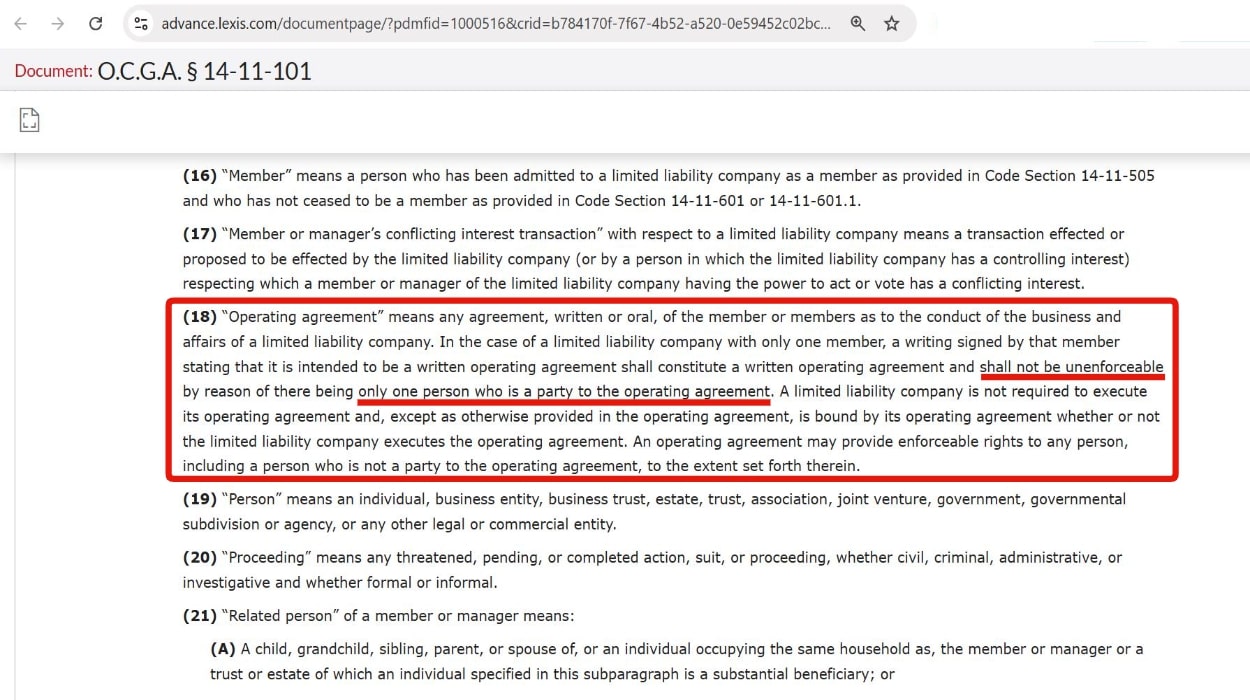
Putting clear internal rules in writing gives the LLC greater flexibility. It also promotes consistent decision-making and supports long-term stability.
1. Replace Georgia’s Default LLC Rules
Unless members set their own terms in writing, a Georgia LLC is governed by state default rules.
Note: Only a written Operating Agreement can effectively replace Georgia’s statutory defaults. Verbal agreements are hard to prove and often result in disputes.
a. Georgia Default Rules For LLCs
Default law controls many internal matters when no written Operating Agreement states otherwise. This is ruled under the Georgia Limited Liability Company Act (Title 14, Chapter 11). In addition to the management structure, default rules cover:
- Voting authority and approval requirements.
- Admission of new members.
- Distribution of profits and losses.
- Authority to bind the LLC.
- Member rights and responsibilities.
A written Operating Agreement allows members to change or replace these default provisions. These can be replaced with rules that better match the LLC’s business needs and structure.
Example: Suppose you own 90% of a Georgia LLC and another member owns 10%.
- The LLC earns profits that are available for distribution. You would reasonably expect to receive 90%.
- However, if the Articles of Organization or a written Operating Agreement don’t address profit allocation, Georgia law applies its default rule.
- Under O.C.G.A. § 14-11-403, the law splits profits equally, and each member receives 50%, regardless of ownership percentage.

b. Why You Should Use An Operating Agreement?
Georgia law lets members modify certain default rules through the Articles of Organization or a written Operating Agreement. Even so, you shouldn’t rely on theArticles of Organization for internal governance.
The Articles of Organization have clear limitations:
- They become public records, so any management or ownership terms you outline are visible to the public.
- Any modifications require a formal amendment and an additional filing fee paid to the state.
Conversely, an Operating Agreement serves as a private, internal document that defines management rules, ownership rights, and member duties in detail.
- It keeps sensitive management and ownership terms off the public record.
- It allows easy updates, since members can revise it internally at any time without filing with the state.
2. Reinforce Liability Protection And Legal Separation
An Operating Agreement strengthens the legal separation between the LLC and its members. This separation is essential for preserving limited liability protection. By precisely documenting ownership, management authority, and decision-making rules, the agreement shows that the LLC operates as an independent legal entity. Therefore, it’s not just an extension of its owners.
This protection matters even more for single-member Georgia LLCs. Without formal internal rules, creditors or courts can more easily argue that the LLC and the owner are the same.
3. Enhance Credibility With Banks, Investors, And Third Parties
A written Operating Agreement increases your LLC’s credibility with banks, lenders, investors, and business partners. In reality, many banks ask for a signed Operating Agreement before opening a business bank account or approving financing. The document confirms who has the authority to act for the LLC.
4. Reduce Internal Disputes And Conflicts
An Operating Agreement prevents disputes by setting clear expectations from the start.
When disagreements occur, the written agreement provides a clear reference for resolving issues objectively. This approach decreases costly conflicts and protects business relationships. Plus, it keeps the Georgia LLC focused on operations instead of internal disputes.
Conclusion
You don’t have to file a Georgia LLC Operating Agreement, but it plays a central role in how your business operates. Without one, Georgia’s default statutes automatically govern your LLC. These rules may not match your intended ownership structure, management authority, or profit arrangements.
When you adopt a written Operating Agreement, you control management powers, profit distribution, voting rules, and dissolution terms. You also keep sensitive details off the public record. A well-written Operating Agreement creates clarity, limits disputes, and supports long-term stability and credibility. This applies whether your LLC has one member or multiple members.
Frequently Asked Questions
No, Georgia law doesn’t require an LLC to create or file an Operating Agreement. That said, a written agreement lets your LLC define management authority, ownership rights, and operating rules clearly. It also replaces default state provisions and strengthens credibility with banks, investors, and third parties.
Yes, all LLCs benefit from a written Operating Agreement, especially single-member LLCs. The document records your authority, strengthens legal separation between you and the LLC, and provides clarity for banks, lenders, and other third parties.
Yes, you can write your own Operating Agreement for your LLC. You can download my templates above and customize them to fit your business needs. If your business has multiple members, complex ownership, or special management arrangements, I highly recommend working with a business attorney to draft one.
2026 Georgia LLC Guides

Starting Your LLC, Made Simple
Navigate each step to form your LLC with a clear roadmap built for new business owners.
ABOUT THE AUTHOR


+ 5 sources
Bizreport adheres to strict editorial integrity standards avoids using tertiary references. We have strict sourcing guidelines and rely on peer-reviewed studies, academic research. To ensure the accuracy of articles in Bizreport, you can read more about the editorial process here.
- Lexis.com. (2025). Georgia General Assembly | PAW Document Page. [online] Available at: https://advance.lexis.com/documentpage/?pdmfid=1000516&crid=b784170f-7f67-4b52-a520-0e59452c02bc&nodeid=AAOAANAACAAC&nodepath=%2FROOT%2FAAO%2FAAOAAN%2FAAOAANAAC%2FAAOAANAACAAC&level=4&haschildren=&populated=false&title=14-11-101.+Definitions.&config=00JAA1MDBlYzczZi1lYjFlLTQxMTgtYWE3OS02YTgyOGM2NWJlMDYKAFBvZENhdGFsb2feed0oM9qoQOMCSJFX5qkd&pddocfullpath=%2Fshared%2Fdocument%2Fstatutes-legislation%2Furn%3AcontentItem%3A6348-FT91-DYB7-W2PH-00008-00&ecomp=6gf59kk&prid=ea67ee43-88ce-4cf0-addc-75447f530e3a.
- Lexis.com. (2025). Georgia General Assembly | PAW Document Page. [online] Available at: https://advance.lexis.com/documentpage/?pdmfid=1000516&crid=aa392eca-e04a-45cd-831c-15b1354fbf9f&config=00JAA1MDBlYzczZi1lYjFlLTQxMTgtYWE3OS02YTgyOGM2NWJlMDYKAFBvZENhdGFsb2feed0oM9qoQOMCSJFX5qkd&pddocfullpath=%2Fshared%2Fdocument%2Fstatutes-legislation%2Furn%3AcontentItem%3A6348-FT91-DYB7-W2RB-00008-00&pdcontentcomponentid=234186&pdteaserkey=sr0&pditab=allpods&ecomp=6s65kkk&earg=sr0&prid=916a4374-c01f-46a2-87e7-1d127fc35eb3.
- Lexis.com. (2025). Georgia General Assembly | PAW Document Page. [online] Available at: https://advance.lexis.com/documentpage/?pdmfid=1000516&crid=157fe56d-5617-4c12-9e86-1bc902c353a4&config=00JAA1MDBlYzczZi1lYjFlLTQxMTgtYWE3OS02YTgyOGM2NWJlMDYKAFBvZENhdGFsb2feed0oM9qoQOMCSJFX5qkd&pddocfullpath=%2Fshared%2Fdocument%2Fstatutes-legislation%2Furn%3AcontentItem%3A6348-FT91-DYB7-W2R6-00008-00&pdcontentcomponentid=234186&pdteaserkey=sr0&pditab=allpods&ecomp=6s65kkk&earg=sr0&prid=97d2334f-b050-4b7e-af55-60981713ba31.
- Lexis.com. (2025). Georgia General Assembly | PAW Document Page. [online] Available at: https://advance.lexis.com/documentpage/?pdmfid=1000516&crid=389f736b-e0c0-4f9f-9fce-ceb2cfee3e62&nodeid=AAOAANAAHAAE&nodepath=%2FROOT%2FAAO%2FAAOAAN%2FAAOAANAAH%2FAAOAANAAHAAE&level=4&haschildren=&populated=false&title=14-11-602.+Dissolution.&config=00JAA1MDBlYzczZi1lYjFlLTQxMTgtYWE3OS02YTgyOGM2NWJlMDYKAFBvZENhdGFsb2feed0oM9qoQOMCSJFX5qkd&pddocfullpath=%2Fshared%2Fdocument%2Fstatutes-legislation%2Furn%3AcontentItem%3A6348-FT91-DYB7-W2S9-00008-00&ecomp=6gf59kk&prid=6125308b-ac74-4cfc-be5e-869ec514cf7a.
- Lexis.com. (2026). Georgia General Assembly |Public Access | Main Page. [online] Available at: https://advance.lexis.com/container/?pdmfid=1000516&crid=4745d871-940d-4c35-8d61-6793cf40fb08&func=LN.Advance.ContentView.getFullToc&nodeid=AAOAAN&typeofentry=Breadcrumb&config=00JAAzZDgzNzU2ZC05MDA0LTRmMDItYjkzMS0xOGY3MjE3OWNlODIKAFBvZENhdGFsb2fcIFfJnJ2IC8XZi1AYM4Ne&action=publictoc&pddocfullpath=%2Fshared%2Fdocument%2Fstatutes-legislation%2Furn%3AcontentItem%3A6348-FT91-DYB7-W2PH-00008-00&pdtocfullpath=%2Fshared%2Ftableofcontents%2Furn%3AcontentItem%3A63RH-PW33-CH1B-T4TR-00008-00&ecomp=h2vckkk&prid=4b1fda54-1a6c-4b58-b485-160423348197 [Accessed 20 Jan. 2026].
- Lexis.com. (2025). Georgia General Assembly | PAW Document Page. [online] Available at: https://advance.lexis.com/documentpage/?pdmfid=1000516&crid=381d481f-1dfd-4780-bf49-0776f38e57fd&config=00JAA1MDBlYzczZi1lYjFlLTQxMTgtYWE3OS02YTgyOGM2NWJlMDYKAFBvZENhdGFsb2feed0oM9qoQOMCSJFX5qkd&pddocfullpath=%2Fshared%2Fdocument%2Fstatutes-legislation%2Furn%3AcontentItem%3A6348-FT91-DYB7-W2RP-00008-00&pdcontentcomponentid=234186&pdteaserkey=sr0&pditab=allpods&ecomp=6s65kkk&earg=sr0&prid=9d4e6d31-c5e3-4c78-b799-0f51450092cb.
0 Comments